The Story
| Format: | LP |
| Label: | Domino |
| Catalogue Number: | REWIGLP65 |
An Ode to the Boys with the Perpetual Nervousness
“Going to the Feelies this evening, Henry?” enquired the Assistant Predestinator. “I hear the new one at the Alhambra is first-rate. There’s a love scene on a bearskin rug; they say it’s marvelous. Every hair of the beast reproduced. The most amazing tactual effects.”
—Aldous Huxley, Brave New World
Like a drop of water shattering the still surface of a pond, the Feelies’ first album starts with the ringing sound of rosewood claves: click, click. Then silence, until again—click, click—this time higher in pitch and richer in reverb. The scattered drops turn into a gentle rain as a needlelike electric guitar repeats a two-note pattern. The song picks up speed, building in intensity; a second guitar echoes the first, and an insistent bass drum charts the pulse. The guitars combine to form a chord, but there’s no relief in the melody, and some raspy sand blocks add a sharp counter-rhythm that cues the uneasy vocals.
“There’s a boy I know but not too well/He hasn’t got a lot to say/Well, this boy lives right next door and he/Has nothing to say.”
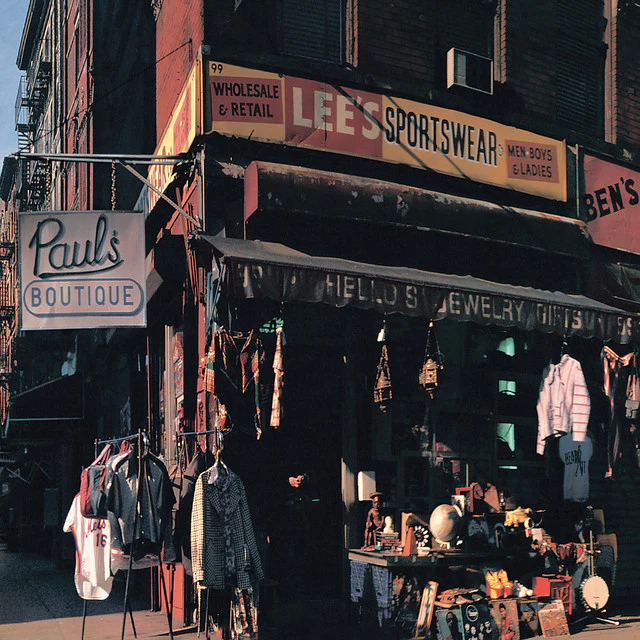
Without ever visiting Haledon, New Jersey, a quiet, hilly suburb of blue-collar Paterson, you know the place the Feelies are singing about—chipped white paint on the shingles, slightly overgrown lawns, tree-lined streets filled with mounds of Autumn leaves—just as the memorable album cover is evocative of the corner table in every high school lunch room in America, the one populated by those introverted members of the chess club and brainy winners of the science fair.
The Feelies don’t romanticize the life of the suburban nerd on Crazy Rhythms any more than they feel stifled or defined by it. It’s just part of who they are, though they’re also into bigger/better things: the Velvet Underground, the Stooges, Brian Eno’s “pop” albums, the Beatles of Revolver and Magical Mystery Tour, the sound of Robert Fripp’s guitar on David Bowie’s “Heroes,” and above all that signature tom-tom-heavy kinetic drum beat, descended from the polyrhythms of ancient Africa by way of Bo Diddley via Maureen Tucker, sped up and turned inside-out so the backbeat sucks you in like a powerful undertow rather than propelling you forward in the traditional rock-roll manner.
Crazy rhythms, indeed.
The shorthand version of the back story leading to this enduring masterpiece starts in Haledon in 1972, when rhythm guitarist and backing vocalist Bill Million heard some noise emanating from a basement or garage courtesy of drummer Dave Weckerman and lead guitarist and vocalist Glenn Mercer. Mercer and Million started writing songs; Weckerman dropped out of the picture for a time, replaced by Vinny DeNunzio; Vinny’s brother Keith joined on bass, and after a few years of near-obsessive woodshedding, the Feelies started driving east on Route 3 through the Lincoln Tunnel to play at C.B.G.B., Max’s Kansas City, and the Mudd Club during the fertile period when punk was morphing into New and then No Wave.
One-upping their predecessors the Talking Heads, the boys arrived as a complete conceptual package with a distinctive look, a unique aesthetic, and a complex and exciting new sound. There’s no doubt that Mercer and Million were mad-scientist perfectionists when it came to duplicating the music they heard in their heads onstage or in the studio, but we can debate how much of their buttoned-down personas was genuine and how much was an act: Even as The Village Voice dubbed them the best underground band in New York circa 1978, the Feelies were telling journalists they disliked playing in Manhattan because driving through the tunnel gave them a headache. This may or may not have been true, but it certainly added to the mystique, and it made for a good story.
More reliable is the tale that Vinny eventually quit because he grew tired of the band’s leaders telling him he couldn’t use his cymbals: The frequencies clashed with their guitars. This opened things up for a more powerful drummer—Anton Fier, who moved to New York from Cleveland after playing with the Electric Eels and Pere Ubu, and who used to take the bus to Haledon to rehearse—and the return of Weckerman, who augmented the rhythms by adding all those delightful percussive touches. It was said that the Feelies prepared for shows around this time by downing several cups of coffee and shaving with electric razors plugged into their amps just before they played, and that the rhythms occasionally got so crazy-fast that Fier became physically ill behind his drum set—though again, these yarns could all be apocryphal.
In any event, the Feelies were never really part of the New York scene, so it isn’t surprising that they wound up signing to far-off Stiff Records, even if they also were an odd perfect match for the English indie that gave us Ian Dury and Wreckless Eric. They recorded their debut album in 1980 over a period of four intense weeks—an unprecedented amount of time for a Stiff band. The album was produced by Million and Mercer, with Mark Abel. “They are the most obstinate people I’ve ever met,” Abel, a former soundman at C.B.G.B., told The New York Rocker. “They had real set ideas of what they wanted. That record was the culmination of four years of fantasizing about how they were going to record those songs.”
The culmination and, we could add some 29 years later, the perfection. I’ve been listening to Crazy Rhythms for three-quarters of my life now, and it has never failed to conjure a distinctive and fully-realized world that exists only in the space between the speakers, lovingly crafted by Mercer and Million with the express intent of transporting the listener somewhere magical. Nearly three decades, and I’m still hearing things I never caught before or marveling anew at the sonic genius: the way the drums play the melody while the guitars hold down the rhythm through the first half of “Raised Eyebrows”; the fact that Mercer and Million are singing “crazy Feelies” instead of “crazy rhythms” at the end of the title track; the minimalist perfection of those four-note snare fills that bridge the verses of “Original Love”; the contrast between Glenn’s tubular lead and Bill’s gorgeous rhythmic strumming on “Fa Cé-La,” or the realization that the hook in the cover of “Everybody’s Got Something to Hide (Except Me and My Monkey)” is a sustained roll on a coat rack.
I could go on and on, and I’m not the only one who feels this way: The long list of this album’s devoted fans starts with famous names such as R.E.M. (whose Peter Buck would help co-produce the Feelies’ second album), Yo La Tengo (Ira Kaplan ran sound for the group on countless nights at Maxwell’s), and Weezer (note the familiar look of the cover of its debut album); filmmaker Jonathan Demme (who cast the group in Something Wild) and author Rick Moody (who apparently used it as the model for the band in his first book, Garden State). But many of those stories are part of the Feelies’ second act, and far be it from me to keep you any longer from experiencing the first. Those crazy rhythms await, the forces are at work, and everything is a heck of a lot better than alright.
Tracklist
1. The Boy With The Perpetual Nervousness
2. Fa Cé-La
3. Loveless Love
4. Forces At Work
5. Original Love
6. Everbody's Got Something To Hide (Except Me And My Monkey)
7. Moscow Nights
8. Raised Eyebrows
9. Crazy Rhythms
Description
| Format: | LP |
| Label: | Domino |
| Catalogue Number: | REWIGLP65 |
An Ode to the Boys with the Perpetual Nervousness
“Going to the Feelies this evening, Henry?” enquired the Assistant Predestinator. “I hear the new one at the Alhambra is first-rate. There’s a love scene on a bearskin rug; they say it’s marvelous. Every hair of the beast reproduced. The most amazing tactual effects.”
—Aldous Huxley, Brave New World
Like a drop of water shattering the still surface of a pond, the Feelies’ first album starts with the ringing sound of rosewood claves: click, click. Then silence, until again—click, click—this time higher in pitch and richer in reverb. The scattered drops turn into a gentle rain as a needlelike electric guitar repeats a two-note pattern. The song picks up speed, building in intensity; a second guitar echoes the first, and an insistent bass drum charts the pulse. The guitars combine to form a chord, but there’s no relief in the melody, and some raspy sand blocks add a sharp counter-rhythm that cues the uneasy vocals.
“There’s a boy I know but not too well/He hasn’t got a lot to say/Well, this boy lives right next door and he/Has nothing to say.”
Without ever visiting Haledon, New Jersey, a quiet, hilly suburb of blue-collar Paterson, you know the place the Feelies are singing about—chipped white paint on the shingles, slightly overgrown lawns, tree-lined streets filled with mounds of Autumn leaves—just as the memorable album cover is evocative of the corner table in every high school lunch room in America, the one populated by those introverted members of the chess club and brainy winners of the science fair.
The Feelies don’t romanticize the life of the suburban nerd on Crazy Rhythms any more than they feel stifled or defined by it. It’s just part of who they are, though they’re also into bigger/better things: the Velvet Underground, the Stooges, Brian Eno’s “pop” albums, the Beatles of Revolver and Magical Mystery Tour, the sound of Robert Fripp’s guitar on David Bowie’s “Heroes,” and above all that signature tom-tom-heavy kinetic drum beat, descended from the polyrhythms of ancient Africa by way of Bo Diddley via Maureen Tucker, sped up and turned inside-out so the backbeat sucks you in like a powerful undertow rather than propelling you forward in the traditional rock-roll manner.
Crazy rhythms, indeed.
The shorthand version of the back story leading to this enduring masterpiece starts in Haledon in 1972, when rhythm guitarist and backing vocalist Bill Million heard some noise emanating from a basement or garage courtesy of drummer Dave Weckerman and lead guitarist and vocalist Glenn Mercer. Mercer and Million started writing songs; Weckerman dropped out of the picture for a time, replaced by Vinny DeNunzio; Vinny’s brother Keith joined on bass, and after a few years of near-obsessive woodshedding, the Feelies started driving east on Route 3 through the Lincoln Tunnel to play at C.B.G.B., Max’s Kansas City, and the Mudd Club during the fertile period when punk was morphing into New and then No Wave.
One-upping their predecessors the Talking Heads, the boys arrived as a complete conceptual package with a distinctive look, a unique aesthetic, and a complex and exciting new sound. There’s no doubt that Mercer and Million were mad-scientist perfectionists when it came to duplicating the music they heard in their heads onstage or in the studio, but we can debate how much of their buttoned-down personas was genuine and how much was an act: Even as The Village Voice dubbed them the best underground band in New York circa 1978, the Feelies were telling journalists they disliked playing in Manhattan because driving through the tunnel gave them a headache. This may or may not have been true, but it certainly added to the mystique, and it made for a good story.
More reliable is the tale that Vinny eventually quit because he grew tired of the band’s leaders telling him he couldn’t use his cymbals: The frequencies clashed with their guitars. This opened things up for a more powerful drummer—Anton Fier, who moved to New York from Cleveland after playing with the Electric Eels and Pere Ubu, and who used to take the bus to Haledon to rehearse—and the return of Weckerman, who augmented the rhythms by adding all those delightful percussive touches. It was said that the Feelies prepared for shows around this time by downing several cups of coffee and shaving with electric razors plugged into their amps just before they played, and that the rhythms occasionally got so crazy-fast that Fier became physically ill behind his drum set—though again, these yarns could all be apocryphal.
In any event, the Feelies were never really part of the New York scene, so it isn’t surprising that they wound up signing to far-off Stiff Records, even if they also were an odd perfect match for the English indie that gave us Ian Dury and Wreckless Eric. They recorded their debut album in 1980 over a period of four intense weeks—an unprecedented amount of time for a Stiff band. The album was produced by Million and Mercer, with Mark Abel. “They are the most obstinate people I’ve ever met,” Abel, a former soundman at C.B.G.B., told The New York Rocker. “They had real set ideas of what they wanted. That record was the culmination of four years of fantasizing about how they were going to record those songs.”
The culmination and, we could add some 29 years later, the perfection. I’ve been listening to Crazy Rhythms for three-quarters of my life now, and it has never failed to conjure a distinctive and fully-realized world that exists only in the space between the speakers, lovingly crafted by Mercer and Million with the express intent of transporting the listener somewhere magical. Nearly three decades, and I’m still hearing things I never caught before or marveling anew at the sonic genius: the way the drums play the melody while the guitars hold down the rhythm through the first half of “Raised Eyebrows”; the fact that Mercer and Million are singing “crazy Feelies” instead of “crazy rhythms” at the end of the title track; the minimalist perfection of those four-note snare fills that bridge the verses of “Original Love”; the contrast between Glenn’s tubular lead and Bill’s gorgeous rhythmic strumming on “Fa Cé-La,” or the realization that the hook in the cover of “Everybody’s Got Something to Hide (Except Me and My Monkey)” is a sustained roll on a coat rack.
I could go on and on, and I’m not the only one who feels this way: The long list of this album’s devoted fans starts with famous names such as R.E.M. (whose Peter Buck would help co-produce the Feelies’ second album), Yo La Tengo (Ira Kaplan ran sound for the group on countless nights at Maxwell’s), and Weezer (note the familiar look of the cover of its debut album); filmmaker Jonathan Demme (who cast the group in Something Wild) and author Rick Moody (who apparently used it as the model for the band in his first book, Garden State). But many of those stories are part of the Feelies’ second act, and far be it from me to keep you any longer from experiencing the first. Those crazy rhythms await, the forces are at work, and everything is a heck of a lot better than alright.
Tracklist
1. The Boy With The Perpetual Nervousness
2. Fa Cé-La
3. Loveless Love
4. Forces At Work
5. Original Love
6. Everbody's Got Something To Hide (Except Me And My Monkey)
7. Moscow Nights
8. Raised Eyebrows
9. Crazy Rhythms